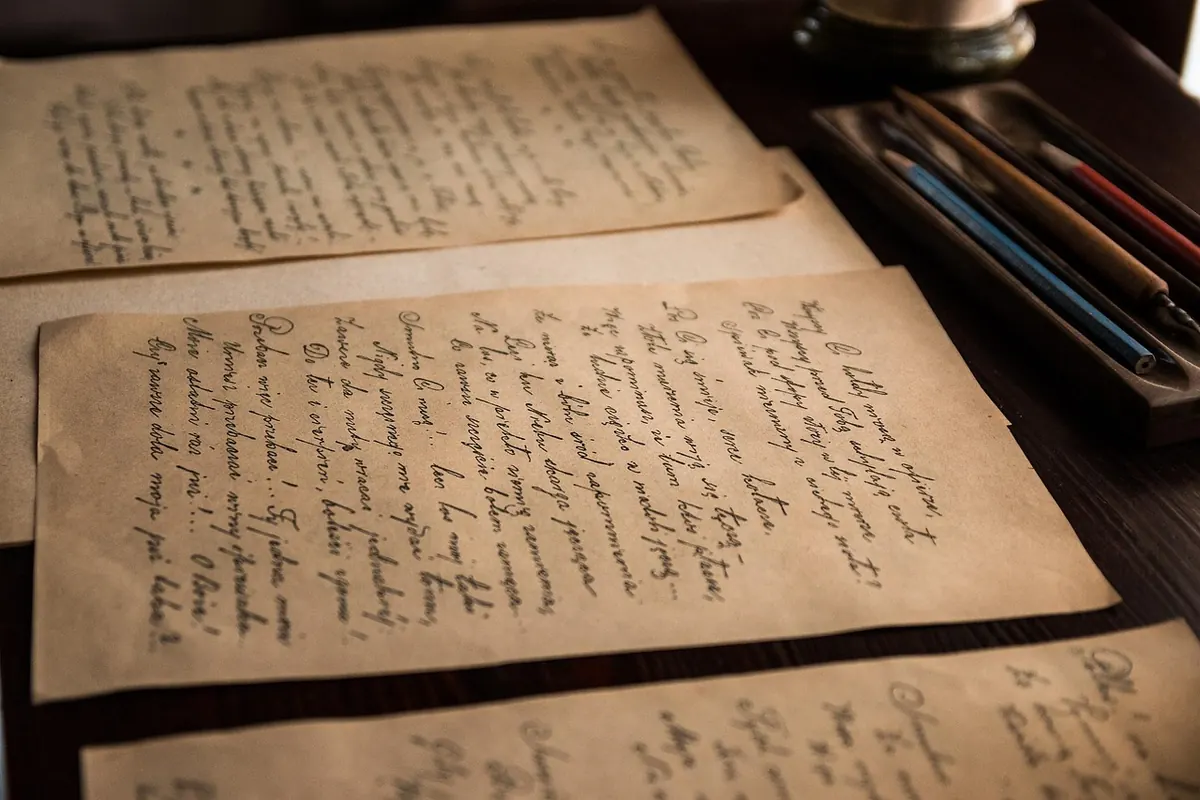
A medieval scribe dipped his pen, and the room around him decided what he would make. In a monastery, the work began with prayer and ended with a book meant for the altar, the refectory, or the library. In a royal chancery, the same ink produced a charter that could transfer a village, a writ that could summon a baron, or a letter that could set an army in motion. Both were writing offices. Both relied on parchment, quill, and Latin. But they answered to different masters, kept different hours, and measured success by different standards.
Understanding that difference matters, whether you are reading a catalogue entry, visiting a cathedral library, or trying to make sense of a document that looks older than it is. The two institutions shaped most of the written evidence that survives from the Middle Ages, and their habits are still legible on the page.
Two Rooms, Two Rhythms
The monastic scriptorium sat at the centre of the cloister. Monks often worked in the cloister walk itself, sheltered from the weather but visible to the community, or in a room set aside near the library. The famous plan of Saint Gall, drawn around 820, places the writing room right beside the church sanctuary, close enough that a scribe could hear the bells and step into the choir without crossing the yard. The day was broken by the Divine Office, so copying fitted between services — an hour here, half an hour there, until the light failed. Some houses assigned a monk a set number of quires to finish. Some abbots complained about brothers who spent too long illuminating a single capital letter. The Rule of St Benedict does not command copying, but by the central Middle Ages it had become a defining monastic labour.
A chancery followed the court. It travelled with the king, or settled wherever the government sat. In twelfth-century England the royal writing office might be at Winchester one month and across the sea in Normandy the next; only later did it take root at Westminster. Work was driven by deadlines: a charter needed sealing before the king left for the frontier, a writ needed to go out with the messenger that afternoon, a treaty needed a fair copy before the envoys departed. Clerks worked near the hall, the treasury, or the chapel, in a space that felt more like an office than a sanctuary — and the seal was its beating heart. No seal, no document, and the keeper of the seals was a man worth knowing.
Who Wrote, and Why
In a monastery, the armarius or precentor usually oversaw the books and the copying. The scribes were monks, and in female houses, nuns. Copying was understood as devotional labour. It could be a penance, a form of prayer, or a way of serving the community without leaving the cloister. Some monks hated it; others found in it a quiet path to God. Scribes often added a colophon at the end of a book, something like Here ends the book; for the scribe, may Christ grant rest — a small plea for mercy wrapped around a hard day's work. The point was not output for its own sake but the library, the liturgy, and the salvation of both copyist and reader.
A chancery was staffed differently. The chancellor or vice-chancellor stood at the head, supported by notaries, scribes, seal keepers, and clerks in minor orders. These men were trained in law and administration rather than in the opus Dei. A chancery post was a career. A capable clerk could rise to a bishopric, a royal council, or a senior administrative office — Thomas Becket served as royal chancellor before becoming archbishop, and later chancellors were routinely bishops and great officers of state. The work was secular in purpose even when the language was sacred.
- Scriptorium: monks, nuns, and oblates; oversight by the armarius; work framed by prayer.
- Chancery: professional clerks, notaries, and sealers; oversight by the chancellor; work framed by law and government.
- Scriptorium: success measured in a finished, correct, beautiful book.
- Chancery: success measured in a valid, sealed, legally effective document.
What Came Out of the Desk
The products differed as much as the people. A scriptorium produced books: Bibles, psalters, breviaries, missals, homiliaries, patristic texts, classical authors, chronicles, and the occasional cartulary. These were objects built to last for centuries, often decorated with gold, colour, and careful initials. A large lectern Bible might take a year or more. A small psalter could be finished in weeks.
A chancery produced documents. Charters and diplomas recorded grants of land and privilege. Writs carried royal commands. Letters patent were sent open, with the great seal hanging from a strip of parchment. Letters close were folded and sealed shut. Treaties, safe conducts, appointments, and licences all passed through the same office. The chancery also kept registers, entering copies of outgoing letters into rolls and books, which is one reason we know so much about royal government and so little about many private transactions of the same period.
Form mattered enormously on both sides, but differently. A monastic book was judged by its text, its accuracy, and its beauty. A chancery document was judged by its formula: the greeting, the notification, the dispositive clause, the date, the witness list, the seal. Change a word in a charter and you might change who owned a mill.
Script, Hands, and the Look of the Page
The two offices even wrote differently. Monastic books were copied in formal book hands — Carolingian minuscule, then the dense gothic textura of the later Middle Ages — with ruled lines, generous margins, columns, red rubrics, and decorated initials. Speed was secondary; legibility and dignity came first.
Chancery clerks used faster, more compressed hands. Cursive scripts with loops, ligatures, and heavy abbreviation were practical tools, and by the fourteenth century English chanceries had developed distinctive hands of their own. A charter is usually a single column of cramped writing, an enlarged first word or two to catch the eye, and a seal at the foot. A book invites you to read slowly. A charter wants you to find the grant, verify the seal, and get on with your business.
Where the Two Worlds Met
They were never entirely separate. Great abbeys kept their own chanceries, issuing leases, charters, and letters sealed with the house's seal, and bishops and cathedral chapters ran offices on the same model. In the other direction, royal and princely households produced books as well as documents, and a chancery clerk might commission a psalter with the same care a monk lavished on one.
The traffic ran both ways in people, too. A monk could serve a king; a royal clerk could end his career as abbot. And cartularies — those great copying projects in which monks transcribed their house's charters into a single volume — physically brought the two traditions onto the same page. When a monastic forger improved a royal diploma in the eleventh century, he was using a scriptorium to imitate a chancery, and doing it well enough to fool historians for centuries.
How to Tell Them Apart Today
- Look at the shape of the object. A bound codex with columns and decoration points to a scriptorium; a single sheet with a seal points to a chancery.
- Read the ending. A colophon asking prayers for the scribe is monastic. A dating clause, witness list, and sealing note are chancery.
- Study the hand. Formal, upright, carefully spaced letters suggest a book hand; compressed, abbreviated cursive suggests an office.
- Ask who benefited. Texts meant for worship, study, or the community's memory belong to the cloister. Texts meant to bind, command, or transfer belong to the chancery.
- Check the corrections. Monastic books were corrected against an exemplar; chancery documents were drafted from formulas kept in a formulary, and errors were often patched with a new clause rather than a new copy.
None of this makes the two institutions enemies. They were partners in the same civilisation, and each depended on the other's habits. The monastery preserved the texts and the language that gave the chancery its authority; the chancery produced the charters that gave the monastery its land. But when you open a medieval manuscript or unroll a charter, you are standing in one room or the other. Knowing which one tells you what the scribe thought he was doing, who was waiting for the finished work, and why the page looks the way it does.
Photo: AnnaER / Pixabay